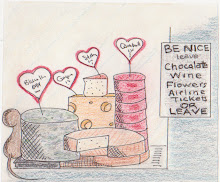
This Boston Globe post on grilled cheese sandwiches around the world (croque monsieur, welsh rarebit, quesadillas), worthy of note in and of itself, led to a search for an appropriate image. We're quite enamoured with the result:
Gorgeous, gorgeous, gorgeous. We're also enamoured with the site it came from, whatwereeating.com, and the post they used this image for: "jalapeno cheese bread...jarlsberg, havarti, and sharp cheddar... tomato soup... fresh vine-ripened tomatoes... sauteed onions, garlic, roasted red peppers, and fresh thyme... garnished with fresh basil pesto and truffle oil..." (Just to give you a sampling.) AND we love the fact that, according to these fine folks, April is National Grilled Cheese Month. Hurray!
As many of you already know, our secret weapon in this arena is using Thai Curry Chedder. Pair with a cold beer. Perfection.
Showing posts with label CHEESE. Show all posts
Recipe: CLASSIC CHEESE FONDUE
(serves 4-6)
A)
1 garlic clove crushed
B)
200-250g Swiss Gruyere shredded
200-250g Swiss Emmenthal shredded*
100g Swiss Appenzeller shredded*
500ml Light Dry White Wine **
Nutmeg freshly grated
Black Pepper freshly ground
Pinch Salt
C)
20 ml Cornstarch
30 ml Kirch ***
D)
1 Crusty Baguette or ½ Boule or ½ crusty wholewheat loaf cubed
METHOD:
1. Rub enameled or heavy stainless steel 2L pot with A), then leave in pot.
2. Add B), place pot on medium heat.
3. Stir continuously 8-10 minutes until cheese has melted and wine has mellowed.
4. Increase heat, to med-high, continue stirring.
5. Combine C) well and add to pot and stir. Continue stirring until mixture has thickened, do not boil.
6. Taste for seasoning, keep warm, and serve.
* For a more complex flavour try “cave aged” Gruyere.
French Comte Gruyere is also a suitable replacement for Swiss Gruyere
** Swiss White wines are not available in BC. Try an Alsatian Pinot Gris or Blanc or blend such as Hugel, “Gentil”
*** Kirch is a distillate of Black Cherries, Swiss is best, although an Austrian Brand, “Schloss” is suitable. Also drink with fondue.
Tradition dictates if a man looses his cubed bread for his fork a round of drinks must be supplied, a woman looses hers a kiss is proffered!
A)
1 garlic clove crushed
B)
200-250g Swiss Gruyere shredded
200-250g Swiss Emmenthal shredded*
100g Swiss Appenzeller shredded*
500ml Light Dry White Wine **
Nutmeg freshly grated
Black Pepper freshly ground
Pinch Salt
C)
20 ml Cornstarch
30 ml Kirch ***
D)
1 Crusty Baguette or ½ Boule or ½ crusty wholewheat loaf cubed
METHOD:
1. Rub enameled or heavy stainless steel 2L pot with A), then leave in pot.
2. Add B), place pot on medium heat.
3. Stir continuously 8-10 minutes until cheese has melted and wine has mellowed.
4. Increase heat, to med-high, continue stirring.
5. Combine C) well and add to pot and stir. Continue stirring until mixture has thickened, do not boil.
6. Taste for seasoning, keep warm, and serve.
* For a more complex flavour try “cave aged” Gruyere.
French Comte Gruyere is also a suitable replacement for Swiss Gruyere
** Swiss White wines are not available in BC. Try an Alsatian Pinot Gris or Blanc or blend such as Hugel, “Gentil”
*** Kirch is a distillate of Black Cherries, Swiss is best, although an Austrian Brand, “Schloss” is suitable. Also drink with fondue.
Tradition dictates if a man looses his cubed bread for his fork a round of drinks must be supplied, a woman looses hers a kiss is proffered!
November Wine Tasting at Mattick's Farm
A relaxing and delicious way to spend a post-Halloween, pre-Christmas-madness afternoon:
Fall Release Tasting at Art Knapp Victoria Garden Centre (next to the Wine Shop)
Fall is here - and with it the new releases from the Cellars of BC's finest
wineries. Join the staff and guest pourer, Wine Educator Dr. Wilf Krutzmann. We will be on hand to answer questions and present an amazing selection of 30- 40 wines from a variety of vineyards. Crisp, fresh whites and luscious reds... The November tasting offers additional special treats - a selection of late harvest and Icewines! You can try them all.
All complimented by a selection of cheeses from Charelli's Delicatessen
Details:
Saturday, November 7th - 7 to 9 pm
Advance tickets only - $30
Contact the Wine Shop for more information 658-3116
Fall Release Tasting at Art Knapp Victoria Garden Centre (next to the Wine Shop)
Fall is here - and with it the new releases from the Cellars of BC's finest
wineries. Join the staff and guest pourer, Wine Educator Dr. Wilf Krutzmann. We will be on hand to answer questions and present an amazing selection of 30- 40 wines from a variety of vineyards. Crisp, fresh whites and luscious reds... The November tasting offers additional special treats - a selection of late harvest and Icewines! You can try them all.
All complimented by a selection of cheeses from Charelli's Delicatessen
Details:
Saturday, November 7th - 7 to 9 pm
Advance tickets only - $30
Contact the Wine Shop for more information 658-3116
British Cheese Week
Lucky Brits - it's Cheese Week in the UK. We should probably show our solidarity and eat lots of extra cheese this week...
Stilton Found to be from.... Stilton!
The origins of Stilton cheese have been a mystery for a long time, but recent events seem to have finally pinned them down to the village of Stilton, of all places. As yesterday's Times article described, "Richard Landy, a local historian, found a letter dated 1722 to Richard Bradley, the first professor of botany at the University of Cambridge, which had a recipe for the cheese attached to it. The author of the letter, Francis Pawlett, wrote of a delicious cheese produced by Cooper Thornhill, the well-known landlord of the Bull Inn, in Stilton." The full story is here.
The Annual Canadian Cheese Rolling Festival
As far as we're concerned, Martha Skinner, Women's 2009 Champion of the Canadian Cheese Rolling Festival, is an honorary Cheese Chick. If you missed the fun this year, there's always next.
Godfrey-Brownell Vineyards

Sometimes we're not in the cheese shop. This week we paid a visit to Godfrey-Brownell Vineyards, who's grapes are located just before Duncan. Turning off the highway, a lush, tiny, winding road leads to a shady terrace with a view out over the vines and an outdoor tasting bar. The proprietor is knowledgeable and passionate without a hint of pretension, and the wines are really lovely. Our favourites: the 2003 Pinot Noir Reserve which is going to wait for a few years yet, and the 2005 Chardonnay, which was enjoyed within a few hours. The Chardonnay is dominated by juicy, rich apples that would pair beautifully with Quicke's Cheddar, brought to us by Neal's Yard Dairy.
Globe & Mail Reviews La Pyramide
A few days ago we posted a link to our interview with The Farmhouse Natural Cheeses. Today, The Globe and Mail's Sue Riedel featured one of our favourite Farmhouse Cheeses - La Pyramide. The story I always tell about this cheese: I took it to the housewarming of some recent immigrants from France and they were so enamoured with it they wouldn't believe it was Canadian! Oh, that cute and endearing Parisian snobbery. An ash ripened goat cheese, this is a really nice one for company - it looks striking and tastes faaaabulous.
Globe & Mail Reviews Grey Owl Goat Cheese
Earlier this month, The Globe and Mail's Sue Riedl reviewed Grey Owl from Fromagerie Le Détour in Notre-Dame-du-Lac, Quebec. It's excellent stuff! (Tastier than this guy. Specialty patés notwithstanding, we wouldn't mess with him.)
Interview with The Farm House Natural Cheeses
The Farm House Natural Cheeses dairy has received international recognition and acclaim - and we're lucky enough to have them in our own back yard. Nestled in the lush Fraser Valley, Debra Amrein-Boyes has run the farm for over twenty years with her husband and children. Debra has taken the time to provide us with thoughtful and beautifully descriptive answers to a few questions we had for them. They really are worth taking a moment to read. They're representative of the care and diligence that goes into making what are no doubt some of the best cheeses in the country - if not the world. Read the interview here.
JUST CHEESE
Colston Bassett
Colston Bassett are one of the smallest Stilton Dairies in the country. They buy milk from 5 farms surrounding the dairy. They have been buying from the same farms since the 1920s. Since 1920, there have only been 4 head cheesemakers at Colston Bassett: Tom Coy, Ernie Wagstaff, Richard Rowlett and now Billy Kevan.
Their Stilton is more traditional than any other. The curd is hand-ladled before draining. This treats the curd more gently and preserves its structure, which results in a luscious, creamy texture when the cheeses are mature.
The cheeses they make for us are made with traditional animal rennet rather than vegetable rennet. Animal rennet is used by the most exacting cheesemakers because it makes better cheese. With Colston Bassett Stilton, the texture is more full-bodied when made with animal rennet and the flavour is deeper, more complex and longer lasting than that of cheeses made with vegetable rennet.
Brie de Meaux-France
Brie de Meaux has a tender, nutty in flavour, creamy texture and rustic rind. In the 19th century is was considered the finest cheese in Europe, thanks to the French statesman, Talleyrand, who introduced it at a diplomats' dinner. It is produced near Paris which has no doubt helped its reputation. Its color is pale yellow, reminiscent of straw. Its rind looks like white velvet. The taste is creamy and as the maturing process continues, one detects a subtle, nutty flavor.
Chevre de Palliot-Canada, Quebec
A slight tangy flavour that becomes more pronounced with age. Chevre de Paillot is a lactic cheese with a crumbly hard central core, and creamy brie like edges.
Cheshire-England
This dense, crumbly cheese derives its mild saltiness from the pastures of Cheshire. England's oldest-known cheese, it is reddish-orange in color and has a slightly tangy flavor. Cheshire is ripened for two to three month. Immensely popular and widely copied,
Mirabella-France
Pale yellow in color with a white-orange rind, it is a very rich and soft cheese with a supple yet firm consistency. It is well known for its delicate bouquet, however it does tend to have a strong, pungent aroma.. The flavour is creamy and full-bodied, especially if you choose to eat the rind (some prefer to trim it).
Oka-Canada, Quebec
Oka, a semi-soft, unpasteurized cow's milk cheese, is known as one of the most popular Canadian cheeses. It is produced from an original recipe brought by the Benedictine monks. These monks originated in Brittany, France, then moved to the village of Oka just outside of Montreal in Quebec to start a new monastery. Oka has a distinctive, full flavour, filled with delicate subtleties. It is mellow, smooth, creamy and a little bit nutty. However, it does tend to have a strong, pungent aroma.
Corsica-France
Corsica is a factory-produced soft cheese with a soft rind, made from ewe's milk. This cheese is very creamy inside in spite of is firmness
Cave Aged Gruyere- Switzerland
Made from rich, unpasteurized, Alpine cow's milk, this Grand Gruyere Reserve has been aged for at least 1 year, compared with the average 4-6 months. A rustic, somewhat oily rind gives way to firm, smooth textured cheese which is slightly aromatic with a robust, assertive flavour.
Etorki-France
Etorki is supple and close textured. Etorki is aged from 3-6 months from fine, cut curd pressed in plastic molds, vertically stacked to press curd and expel whey. After a two-hour brine bath, it is rubbed with salt and later in brine soaked cloths. Etorki is oily with butterfat, yet firm and supple with a burnt caramel sweetness and a creamy texture.
Manchego-Spain
Manchego is Spain's most famous cheese. Produced in La Mancha in Central Spain, true Manchego is made from 100% sheep's milk. The abundance of wild herbs on Central Spain's grazing lands gives Manchego a special taste and aroma. Its flavour is zesty and exuberant while its texture is firm but not dry. Manchego can be recognized by the zigzag pattern etched into its rind. This is created by the rippled surface of the press used in the manufacture of the cheese. Underneath the inedible rind, the interior is ivory colour with few small holes.
STRATHDON BLUE
STRATHDON BLUEMILK
Pasteurised Cows Milk
RENNET
Traditional Animal Rennet
MADE BY
Ruaraidh Stone
REGION
Tain, Ross-shire
SEASON
All year round
APPEARANCE & RIND
Sticky blue-green millstone shaped cheeses with a
wrinkled rind. The interior is a whitish-cream with distinct lines of blueing.
FLAVOUR & TEXTURE
When ripe, this cheese has a soft, yielding texture more like a continental blue than a Stilton. The flavours are milky and savoury – sometimes quite salty – alleviated by the blue.
Until recently, Ruaridh (pronounced Rory)’s family were best known for a simple, traditional Caboc allegedly made from a recipe of family ancestor Mariota de Ile, daughter of The MacDonald, Lord of the Isles. In the past 3 or 4 years however, in his converted brewery by the sea (now a cheese dairy), he's begun making a blue cheese he calls Strathdon Blue.
Milk is bought from a local six-herd cooperative, which includes one herd of Ayrshires and the rest are Holstein-Friesians. Ayrshires are a traditional Scottish dairy breed and reputedly produce excellent milk for cheesemaking and Ruaraidh believes that this adds a touch or richness to the cheese.
The recipe is still in progress as Ruaraidh likes to experiment. He has changed rennet and ways of salting, to name but two things, and the cheese has developed over the couple of years in which we’ve sold it from a crumbly cheese to one that is rich, full and creamy.
Small Batches
Neal’s Yard Dairy in London works as a dairy co-operative that stocks and distributes some 80+ artisan cheeses produced in small batches around Ireland and Great Britain.
These small produced cheeses are made by hand with natural ingredients and traditional methods. They have subtle flavours that vary from batch to batch but showcase their uniqueness with grassy notes, sharp flavours, and often a slightly gamey, earthy flavour. Often artisan cheeses reveal characteristics of the environment they are produced. The cattle are fed draft in some cases because grass is sparse, or at certain times of the year cheeses like Morbier and Comte taste better and look different in colour because of what the season and what the cattle is eating. Cows who graze on fresh aromatic herbs give a distinctive flavour to the milk which in turn affects the cheeses flavours.
Unpasteurized milk also provides another distinct taste in cheeses. Although often difficult to obtain in Canada because of trade regulations, raw milk cheeses tend to be creamier and carry more character than their counterparts.
Colston Bassett Stilton and Colston Bassett Shropshire Blue are prime examples of this. Compared side by side with those made industrially the difference is immediately present. Stiltons from Neal's Yard Dairy are made in a more traditional method with traditional rennet and an allowed a slower ripening time. The result is a distinctive cheese that is nuttier, creamier, and richer and presents more character than supermarket stiltons.
Good things are often worth the wait, and these small batches of special cheeses definitely deserve more attention as hand made classics and to be savoured as one would savour a special vintage of wine.
These small produced cheeses are made by hand with natural ingredients and traditional methods. They have subtle flavours that vary from batch to batch but showcase their uniqueness with grassy notes, sharp flavours, and often a slightly gamey, earthy flavour. Often artisan cheeses reveal characteristics of the environment they are produced. The cattle are fed draft in some cases because grass is sparse, or at certain times of the year cheeses like Morbier and Comte taste better and look different in colour because of what the season and what the cattle is eating. Cows who graze on fresh aromatic herbs give a distinctive flavour to the milk which in turn affects the cheeses flavours.
Unpasteurized milk also provides another distinct taste in cheeses. Although often difficult to obtain in Canada because of trade regulations, raw milk cheeses tend to be creamier and carry more character than their counterparts.
Colston Bassett Stilton and Colston Bassett Shropshire Blue are prime examples of this. Compared side by side with those made industrially the difference is immediately present. Stiltons from Neal's Yard Dairy are made in a more traditional method with traditional rennet and an allowed a slower ripening time. The result is a distinctive cheese that is nuttier, creamier, and richer and presents more character than supermarket stiltons.
Good things are often worth the wait, and these small batches of special cheeses definitely deserve more attention as hand made classics and to be savoured as one would savour a special vintage of wine.
Subscribe to:
Posts (Atom)